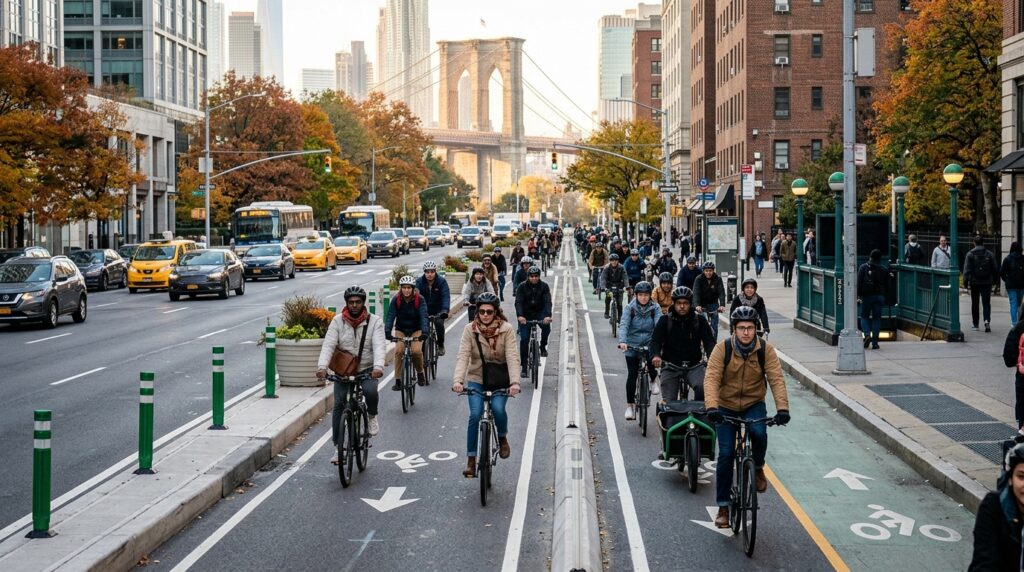
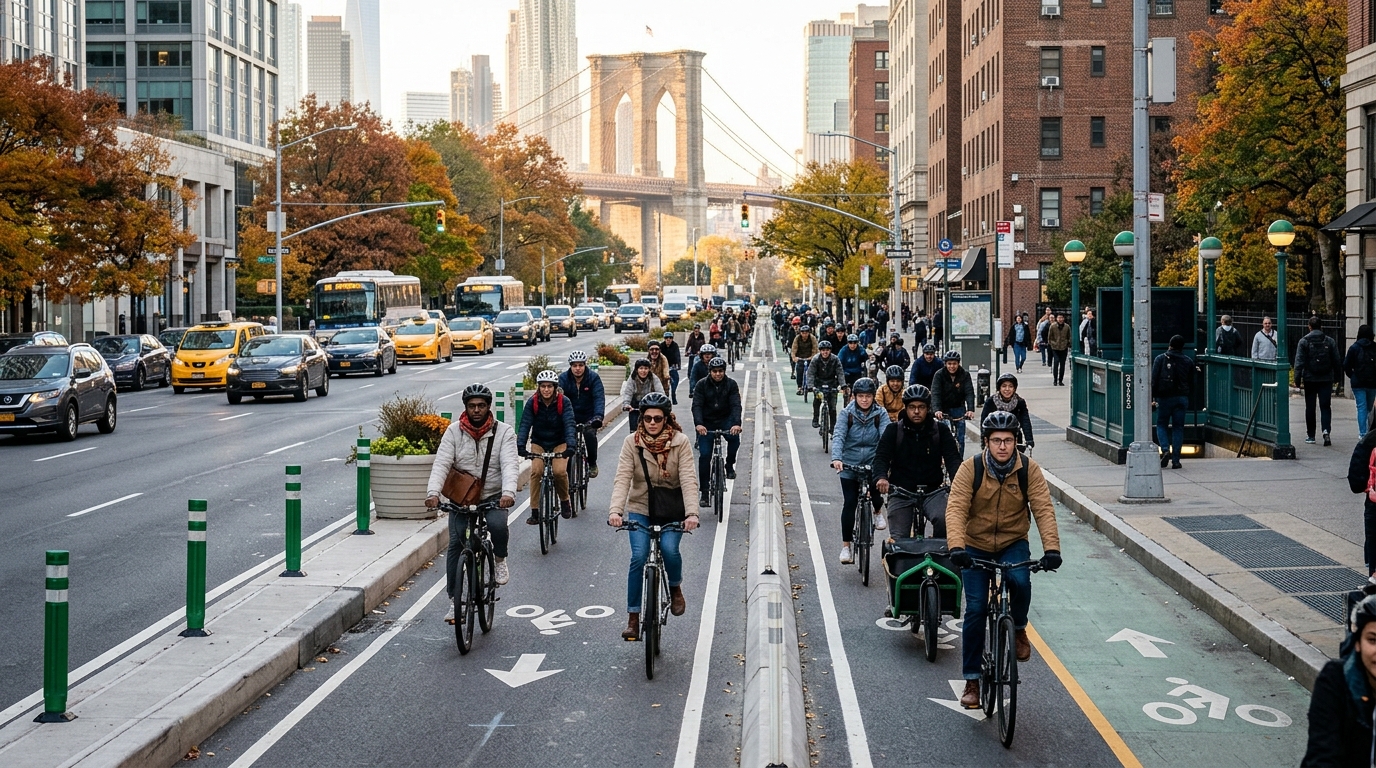
The Brooklyn Bridge bike lane upgrade 2026 is changing one of New York City’s busiest cycling connections. NYC DOT has started work on Boerum Place and Adams Street in Brooklyn, where thousands of riders travel toward the Brooklyn Bridge each day.
The project matters because the bridge itself is only one part of a bicycle commute. A protected crossing can still feel difficult if the streets leading to it are blocked, narrow, or poorly connected.
That has been a recurring problem on Adams Street. The existing bike lane is often blocked by double-parked vehicles, even though more than 1,300 cyclists use the corridor on a typical weekday.
NYC DOT is now redesigning the route with a two-way protected bike path and stronger connections through Downtown Brooklyn and DUMBO.
The work begins during Biketober, New York City’s annual October cycling campaign. It also arrives as Brooklyn Bridge bike traffic continues to grow.
This guide explains what is changing, which sections come first, and why the project offers a useful lesson for cities building serious commuter cycling networks.
What the Brooklyn Bridge Bike Lane Upgrade 2026 Will Change
The full project covers just over one mile between Bergen Street in Boerum Hill and Front Street in DUMBO.
Along much of that route, Adams Street is known as Boerum Place farther south. The corridor links neighborhoods, Downtown Brooklyn streets, protected lanes, and the Brooklyn Bridge.
NYC DOT plans to convert the existing standard lane on Boerum Place and Adams Street into a two-way protected bike path between Bergen Street and Johnson Street.
Construction will happen in stages. The first major section moves forward in 2026.
Atlantic Avenue to Tillary Street Comes First
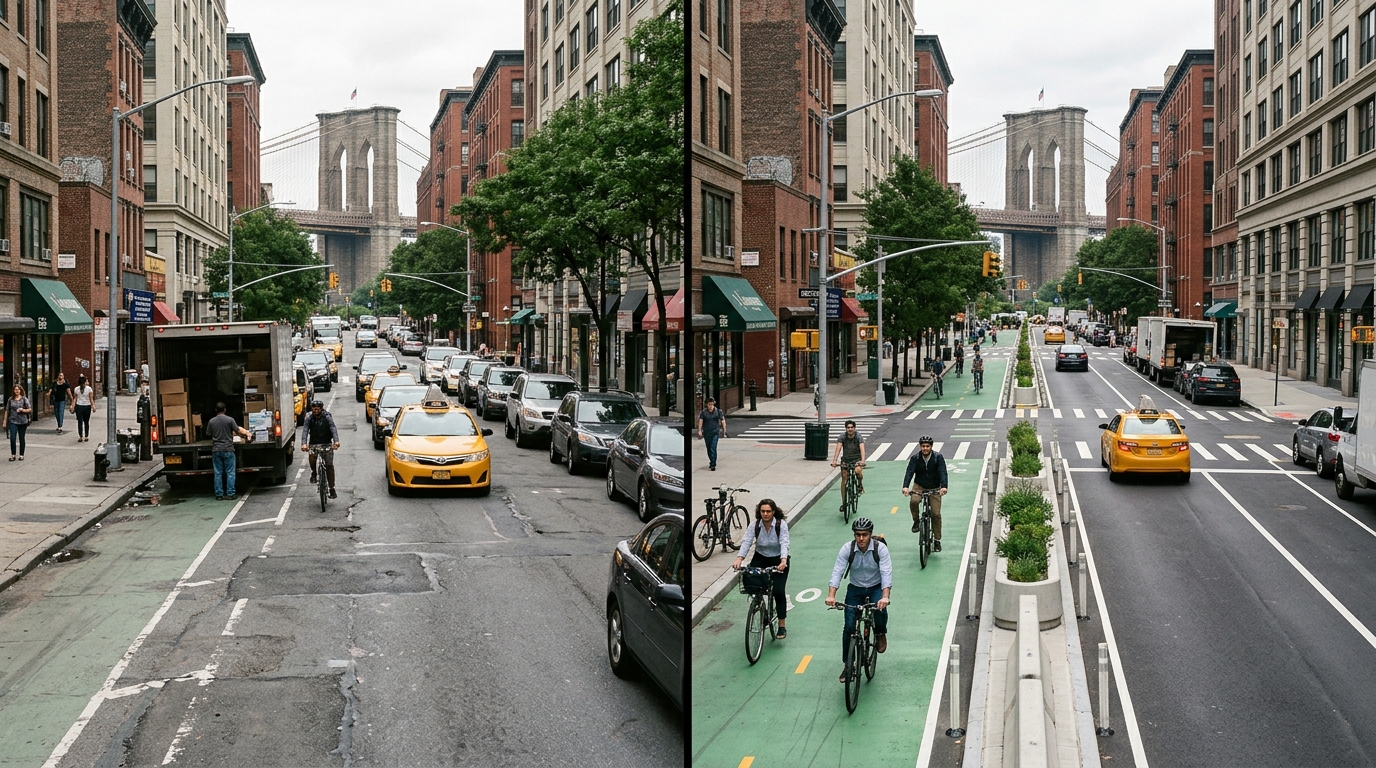
The 2026 phase focuses on Boerum Place and Adams Street between Atlantic Avenue and Tillary Street.
This is an important stretch because Tillary Street sits close to the Brooklyn Bridge entrance. Riders using the bridge often pass through this corridor before crossing into Manhattan.
The section between Bergen Street and Atlantic Avenue is scheduled for a later phase in 2027.
That means riders should not assume the full one-mile protected route will appear at once. The network will improve in stages.
The Existing Lane Has a Double-Parking Problem
The current Adams Street bike lane illustrates a basic weakness of paint-only infrastructure.
A lane may appear on a city map yet become unreliable when drivers use it for loading or double parking.
That forces cyclists to merge into moving traffic. It also creates unpredictable conflicts at exactly the point where riders want a clear path toward the bridge.
NYC DOT says more than 1,300 cyclists were observed using Adams Street on a typical weekday despite those problems.
A protected path can reduce that type of obstruction because physical separation makes the space harder to treat as an informal loading lane.
Protection does not solve every problem. Intersections, loading activity, turning vehicles, pedestrians, and maintenance still matter.
However, separation changes the basic expectation. The bike route becomes transportation space rather than pavement that drivers may treat as available when convenient.
This connects directly with our guide to why cities are building wider protected bike lanes in 2026. A successful bikeway needs more than painted boundaries. It needs enough width, separation, and continuity to function during real rush-hour conditions.
The Project Connects More Than the Brooklyn Bridge
The redesign is valuable because it links several pieces of the cycling network.
The new path will connect toward the protected bike lanes on Schermerhorn Street. NYC DOT also points to future bike boulevard work on Bergen and Dean streets.
Those connections matter because commuters rarely begin their trip at the entrance to a bridge.
A rider may start several neighborhoods away. Another may be connecting from a train station, school, office, apartment, or waterfront route.
Every weak segment affects the entire trip.
A bridge can have excellent cycling infrastructure, but the network still feels incomplete if riders must enter mixed traffic immediately after leaving it.
That is why the Adams Street work should be understood as a network project rather than simply another short bike lane.
Brooklyn Bridge Cycling Has Grown Dramatically Since 2021
The timing reflects a major increase in demand.
NYC DOT says the Brooklyn Bridge now carries an average of 5,625 cyclists each day.
That represents a 112% increase from 2021, when average daily bicycle traffic was 2,652.
The year 2021 was important because New York converted a vehicle lane on the bridge into a dedicated bicycle path.
Before that change, cyclists and pedestrians shared the elevated promenade. Crowding created conflicts between visitors taking photographs, people walking, and riders trying to make a transportation trip.
The dedicated path gave cycling its own space.
As ridership grew, another issue became clearer. The bridge approach also needed to improve.
More Riders Change What a Useful Bike Lane Needs to Do
A bikeway designed for a smaller number of confident cyclists may struggle as cycling becomes more popular.
Today’s New York bike network serves commuters, delivery workers, tourists, families, e-bike riders, cargo bikes, and people making short everyday trips.
Those riders travel at different speeds and need different amounts of space.
E-bikes add another layer. Electric assistance makes longer trips easier, but it can also increase speed differences inside a narrow lane.
Our 2026 e-bike commuting guide explains why width, visibility, passing room, and predictable behavior matter more as conventional bicycles and electric bikes share the same infrastructure.
The Adams Street redesign will not remove every conflict. Yet a two-way protected facility provides a clearer structure than a narrow lane repeatedly interrupted by parked vehicles.
The Brooklyn Bridge is also part of a larger pattern. NYC DOT says more than 30,000 cyclists now cross the East River bridges each day.
That level of demand makes bridge approaches important pieces of transportation infrastructure rather than optional recreational routes.
Why the Adams Street Project Matters Beyond New York City
The most useful lesson from the project is simple: cycling networks succeed or fail at their connections.
Cities often build impressive individual facilities. A bridge gets a protected lane. A waterfront gains a greenway. A downtown street receives a separated path.
The difficult work comes next.
Those projects need to connect with one another through ordinary city streets.
For daily riders, a commute is only as comfortable as its most stressful section.
A Protected Bridge Needs Safe Approaches on Both Sides
New York has already improved the Manhattan side of the Brooklyn Bridge. The Adams Street work strengthens the Brooklyn approach.
NYC DOT is also extending the network into DUMBO.
A protected bike lane is planned on Adams Street from Sands Street to York Street. A standard lane will continue north between York Street and Front Street.
Sands Street will also receive an upgrade between Jay Street and Adams Street.
Together, these pieces create more route choices around the bridge rather than sending every cyclist through the same weak connection.
That matters for reliability.
Commuters value predictability. A route becomes useful when a rider can expect roughly the same safe path each morning instead of improvising around parked cars or missing lane segments.
The Best Commuter Network Is One Riders Can Repeat Every Day
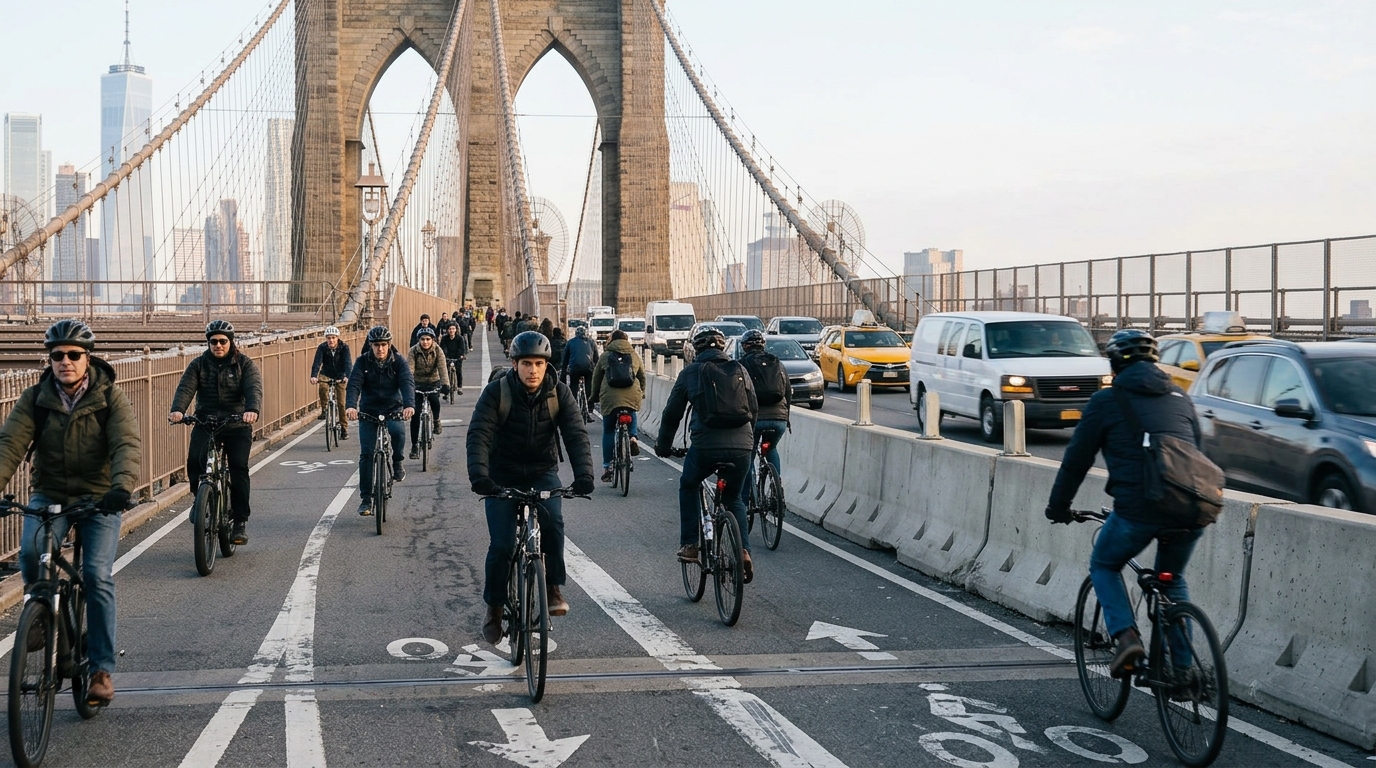
A bicycle commute does not need to be spectacular. It needs to work repeatedly.
That means predictable intersections, clear lane transitions, enough room to pass, and connections that do not suddenly disappear.
Weather matters too.
A good route should remain useful when heat, rain, wind, or changing daylight affects the ride. Our extreme heat and bike commuting guide explains why resilient cycling networks also need shade, route choices, and practical alternatives.
New York’s Biketober programme adds another useful element: rider support.
NYC DOT is pairing infrastructure work with free helmet and bike-light giveaways, safety education, and learn-to-ride programmes across the five boroughs.
Infrastructure and education solve different problems.
A helmet cannot fix a blocked bike lane. A protected lane cannot teach a new rider how to brake smoothly or signal before turning.
Cities need both.
The Brooklyn Bridge bike lane upgrade 2026 shows what happens after a successful piece of cycling infrastructure attracts more riders.
The original bridge bike path created a safer dedicated crossing. Growth then exposed weak connections on the streets leading to it.
Now Adams Street and Boerum Place are being redesigned around that larger demand.
The 2026 phase between Atlantic Avenue and Tillary Street is only part of the full project. The Bergen Street to Atlantic Avenue section is expected to follow in 2027, while additional DUMBO connections will improve access north of the bridge approach.
For commuters, the practical benefit is not simply another green lane on a map.
It is the possibility of a more continuous trip from neighborhood streets to Downtown Brooklyn, across the Brooklyn Bridge, and into Manhattan.
That is the difference between building isolated cycling facilities and building a transportation network.
For current construction information and Biketober updates, check NYC DOT’s official Brooklyn Bridge cycling access announcement before planning around active street work.