For years, the basic argument for protected bike lanes was simple: give people on bicycles physical separation from moving traffic and more people will feel comfortable riding. In 2026, the conversation is becoming more specific. Cities are no longer asking only whether a bike lane should be protected. They are increasingly asking whether it is wide enough, connected enough, and designed for the mix of riders now using it.
That shift matters because the urban bicycle lane now carries more than the traditional commuter bike. It may need to accommodate e-bikes, cargo bikes, adaptive cycles, parents riding with children, delivery riders, slower recreational cyclists, and commuters who need room to pass. A narrow strip can technically qualify as bicycle infrastructure while still feeling stressful at rush hour. The next generation of protected lanes is being designed more like transportation infrastructure and less like leftover roadway space.
New York City offers a timely example. In April 2026, NYC DOT proposed a two-way protected bike lane across the full length of 72nd Street in Manhattan, designed to connect Central Park with both the Hudson River Greenway and East Side Greenway. The proposal also aims to shorten pedestrian crossing distances and improve safety at intersections. The larger story is the growing recognition that a useful bike network depends on width, separation, intersection design, and connections working together.
Why the Protected Bike Lane Is Getting Wider
Protected lanes change the experience of riding beside cars by creating more predictable separation than paint alone. But once a facility succeeds and attracts more riders, another problem appears: capacity. Riders travel at different speeds, some need more physical space, and passing becomes difficult when the lane was designed around the narrowest possible dimensions.
Modern Bike Traffic Is More Diverse Than It Used to Be
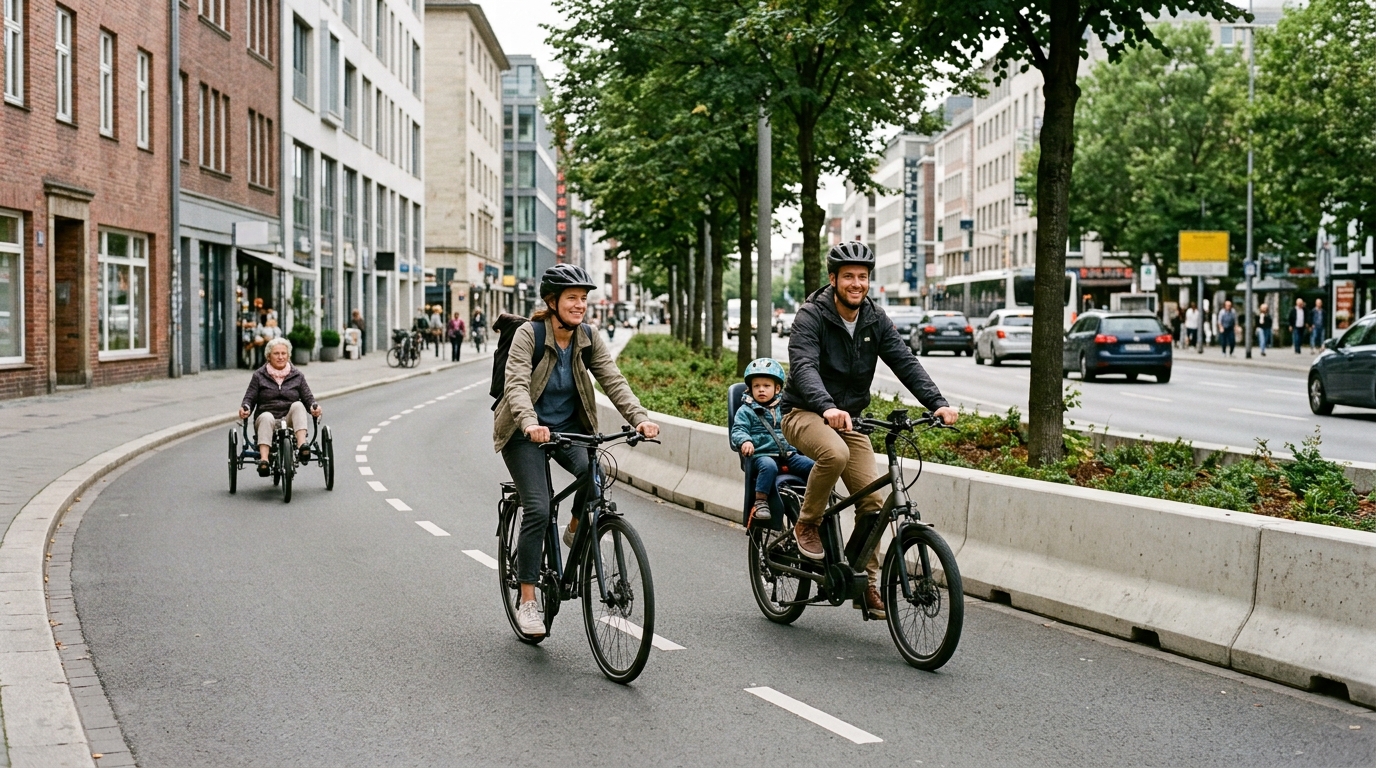
A city bikeway in 2026 may carry a parent on a long-tail cargo bike, a commuter on a standard bicycle, an e-bike rider moving at a steadier pace, and someone using an adaptive cycle. Those vehicles do not have identical widths, turning characteristics, or speeds. Good infrastructure has to acknowledge that diversity instead of treating every cyclist as a single standard design user.
Passing space is becoming a basic design requirement
NACTO’s current Urban Bikeway Design Guide recommends enough rideable width for people to travel side by side, move in groups, or pass one another comfortably. For one-way protected bike lanes, the guide identifies a minimum rideable width of roughly 6.5 to 7 feet and a preferred range of about 8 to 12.5 feet. Those dimensions move the conversation beyond a narrow minimum and toward the amount of usable space a busy lane actually needs.
Width becomes especially important when e-bikes and conventional bikes share the same corridor. A slower rider may feel pressured when a faster rider sits closely behind, while the faster rider may make a risky pass if there is no room. Extra width lets people choose their own pace without turning every speed difference into a conflict.
This is why the future of city cycling cannot be judged only by how many miles of bike lanes appear on a map. A network can look impressive in total mileage and still feel fragmented if lanes pinch down, disappear at intersections, or leave riders with no safe way to pass. Our City Stories section explores how these design differences shape the real experience of moving through urban streets.
Cargo bikes and adaptive cycles need more room
Wider lanes are not simply a luxury for confident commuters. Cargo bikes may be wider and longer than standard bicycles, especially when carrying children or goods. Adaptive cycles can have very different footprints. Riders traveling side by side with a child also need more room than a solo commuter.
NACTO’s guidance recognizes that a more diverse mix of devices requires wider bikeways. That reflects an important change in street design: instead of building around the most agile adult rider, cities can design for families, older adults, new riders, disabled riders, workers carrying equipment, and people making everyday trips rather than training rides.
Protection Is About More Than Putting Up a Barrier
A protected lane needs both usable riding space and meaningful separation from motor traffic. Depending on the street, that separation might come from a curb, median, parking lane, flexible delineators, or another physical treatment. The buffer matters because riders naturally move away from objects, car doors, walls, and fast traffic. A lane that measures well on paper can feel much narrower if a large portion of it is effectively unusable.
Parking-protected lanes need a real door buffer
Parking can provide effective separation between cyclists and moving vehicles, but it introduces another hazard: opening car doors. NACTO recommends a three-foot buffer next to parking to accommodate the full swing of a door and reduce dooring risk. That space should not be counted as normal rideable width. A city cannot simply place a bike lane behind parked cars and assume the design is finished.
Visibility near intersections is equally important. Parked vehicles, planters, and barriers can block sight lines between cyclists and turning drivers. Riders should still slow down where visibility is limited, watch for turning vehicles, expect pedestrians to cross the lane, and stay alert around loading areas. Infrastructure can reduce exposure to traffic, but predictable riding remains part of a safer daily routine. More practical advice belongs in our Commuter Guides.
Maintenance determines whether width stays usable
A wide lane is only wide if riders can actually use it. Debris, snow, standing water, damaged barriers, delivery carts, and illegally parked vehicles can quickly turn a generous facility into a narrow obstacle course. NACTO notes that cities also have to consider whether sweeping and snow-removal equipment can physically fit inside protected lanes.
New-project photos show a lane when it is clean and freshly built, but commuters experience it during rain, construction, delivery hours, and months after barriers have been hit. Good infrastructure therefore needs an operating plan for cleaning, drainage, repairs, snow clearance where necessary, and enforcement against blockage.
What Better Bike Lanes Could Change About the Daily Commute
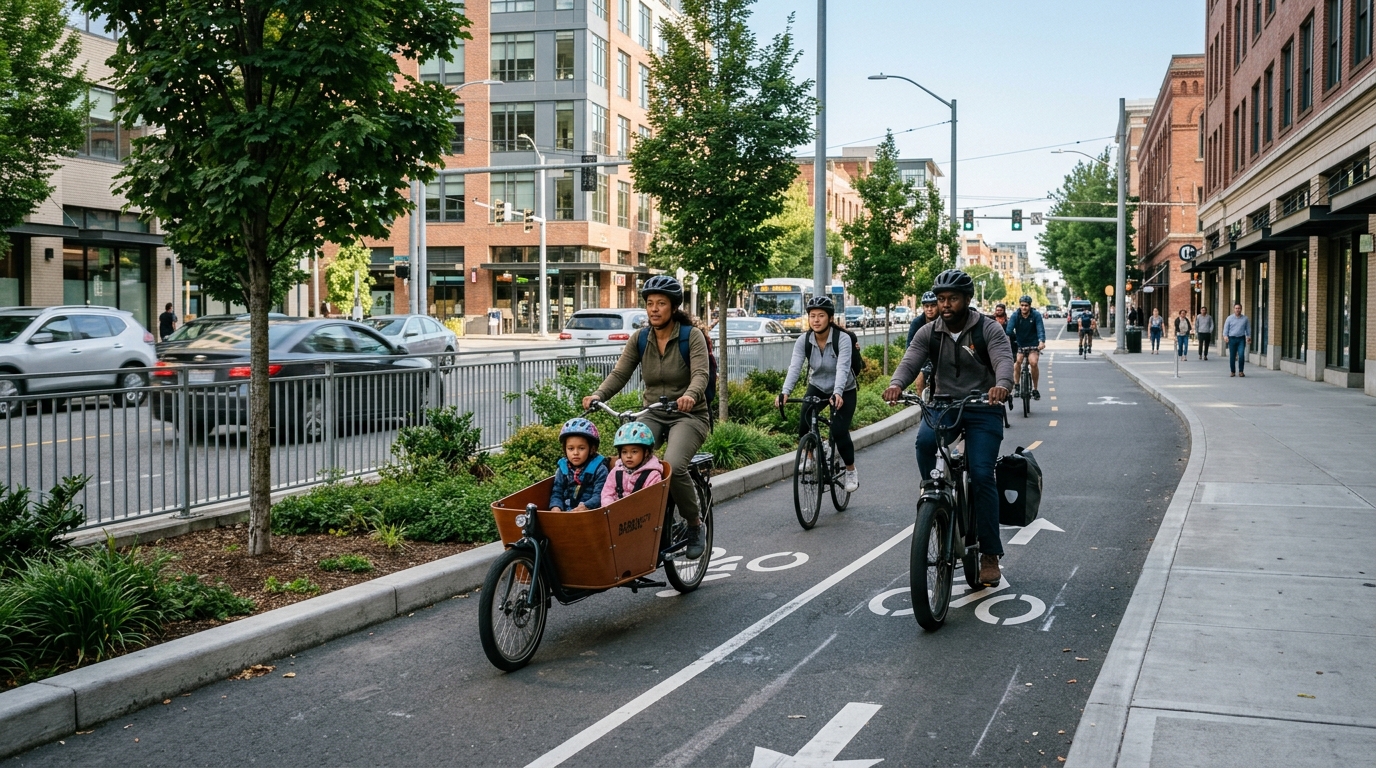
When protected lanes are wide, continuous, visible, and maintained, they can make cycling feel like a normal part of the transportation system. A commuter does not have to be unusually brave to use a route, and a parent does not have to decide whether a narrow painted lane is appropriate for a child. The infrastructure does more of the work.
Connected Networks Matter More Than Isolated Showcase Projects
The most useful protected bike lane is one that leads somewhere. The 2026 proposal for Manhattan’s 72nd Street is notable because its purpose is connectivity: linking Central Park and existing protected networks with major greenways on both sides of Manhattan. That is the kind of planning that turns separate facilities into a network.
A protected lane that ends abruptly at a large intersection can move the hardest part of the commute rather than solve it. Riders need understandable transitions, safe crossings, access to destinations, and connections to train stations, schools, workplaces, parks, and other routes. The same principle applies to bike parking. A comfortable trip loses some of its value if there is nowhere secure to leave the bicycle at the destination.
For cities, the challenge is to allocate street space around actual transportation goals. NACTO notes that motor-vehicle lanes can often be narrowed to support wider bicycle facilities, particularly on lower-speed urban streets. Street width is finite, so priorities eventually have to show up in the pavement.
commuters
For commuters, wider protected lanes signal a more mature phase of cycling infrastructure. The question is no longer simply, “Is there a bike lane?” Better questions are: Can two people pass safely? Can a cargo bike fit? Does the lane stay protected through intersections? Is there enough buffer from parked cars? Does it connect to the next part of the trip?
Those questions connect to the broader culture of urban riding. Our Cycling Culture coverage explores how streets and design shape everyday movement, while Riders focuses on the people using those systems. Infrastructure may look like engineering on a plan, but its success is ultimately measured in ordinary decisions: whether someone feels comfortable riding to work, whether a parent chooses a cargo bike for school drop-off, or whether a new rider is willing to try the route.
Wider protected bike lanes are not the answer to every transportation problem, and width alone cannot fix a poorly connected network. But the trend reflects an important realization: successful cycling infrastructure needs room to succeed. As more kinds of riders use city bikeways, designing only for today’s minimum demand can create tomorrow’s bottleneck.
The best networks will be built for the riders coming next, not just those already confident enough to use the street today. In 2026, that is a clear sign that urban cycling is moving from a niche accommodation toward a serious part of city transportation.